Category: Uncategorized

  • How to Size Custom Soccer Socks for a Team: A Shoe-Size Guide

    How to Size Custom Soccer Socks for a Team: A Shoe-Size Guide

    Most problems with a team sock order are not about color or logo placement — they are about size. A box of custom socks that photographs beautifully is useless if half the squad is swimming in them or straining the cuff over a shin guard. The good news is that soccer socks are sized to be forgiving: each knitted size stretches across several shoe sizes, so a whole club can usually be kitted in two or three bands. The trick is knowing how those bands map to feet, and ordering to the specific maker’s chart rather than a generic guess.

    This guide covers how sock sizing actually works, how to read a size chart by shoe size, how to handle mixed or international rosters, and how to size a full team quickly without measuring every foot.

    How soccer sock sizing works

    Unlike a shoe, a soccer sock is not cut to a single foot length. It is knitted from stretchy yarn and designed to pull up over the calf to hold a shin guard, which means one size deliberately spans a wide range of shoe sizes. That is why you will almost never see socks sold in single shoe sizes; instead they come in a handful of bands — commonly a small, medium, and large — each of which comfortably fits players several shoe sizes apart. The practical upside is that you do not need a different sock for every foot on the roster. A youth team often fits entirely in one or two bands, and a senior squad usually splits across just two.

    Fit still matters within that stretch. A sock sized too small will feel tight at the cuff, slide down as it fights to stay up, and wear through faster at the heel and toe. A sock sized too large bunches inside the boot and bags at the ankle. The stretch buys you tolerance, not immunity, so you still want each player in the band their shoe size actually falls in.

    Reading a size chart by shoe size

    The cleanest way to order is by shoe size, because every player already knows theirs. A typical three-band chart maps roughly to US shoe sizes as a small covering the youth range, a medium bridging older youth and smaller adult feet, and a large covering adult sizes. Because the bands are built to overlap, a player who sits right on a boundary can usually go either way, and the sensible tiebreaker is to size up: the larger band gives more length to cover the shin guard and puts less strain on the cuff.
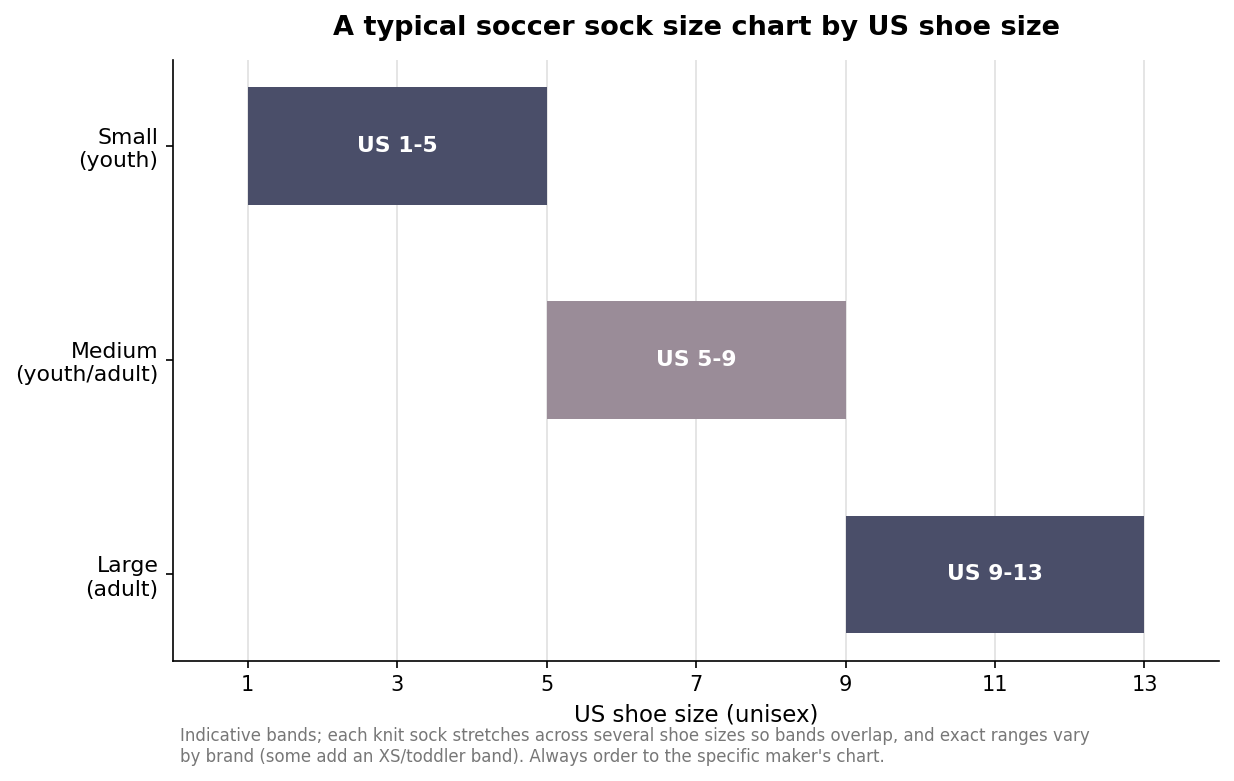
    Horizontal range bars mapping small, medium, and large soccer sock bands to US shoe size ranges, showing the bands overlap
    A typical three-band sock chart by US shoe size; bands overlap because the knit stretches, and exact ranges vary by brand.

    The important caveat is that these ranges are indicative and vary by manufacturer. Some brands run a four-band system that adds an extra small or toddler size and shifts the adult boundary by half a size or so, which means a “medium” from one maker is not identical to a “medium” from another. Never assume the bands are universal. Pull the actual size chart for the exact sock you are ordering, match each shoe size to that chart, and you will avoid the most common cause of a mis-sized team order.

    Mixed and international rosters

    Two complications trip up team orders. The first is that women’s and men’s US shoe sizing are offset — women’s sizes run roughly one and a half sizes higher than men’s for the same foot — so a mixed-gender roster collected as raw shoe numbers needs that offset applied before it maps cleanly onto a unisex sock chart. The second is that many sock charts, especially from European brands, are printed in EU or UK sizes, while your players know their feet in US numbers.
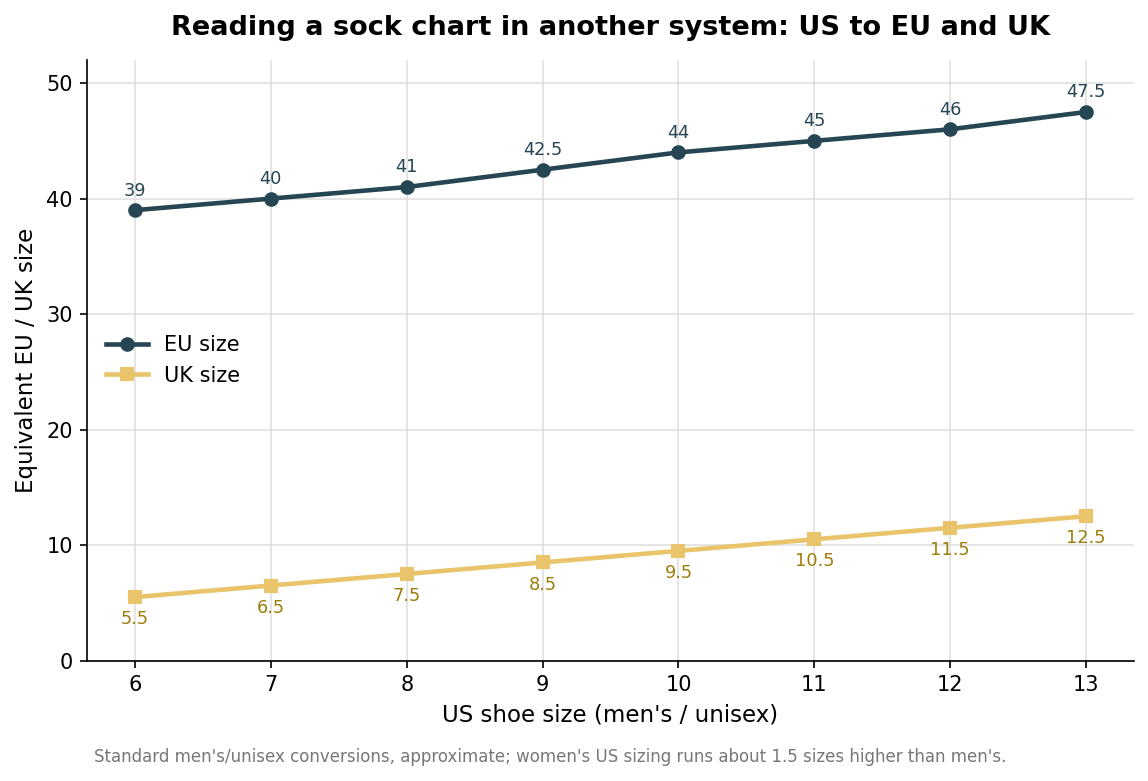
    Line chart converting US men's shoe sizes 6 to 13 into equivalent EU and UK sizes for reading a sock chart in another system
    US-to-EU and US-to-UK shoe size conversion for rosters ordering from a chart printed in another system.

    Keeping a simple conversion on hand removes the guesswork. A US men’s 9 is about an EU 42.5 and a UK 8.5; a US 11 is roughly an EU 45 and a UK 10.5. If you collect the roster in US sizes but the sock chart is in EU, convert first and then place each player into the band — do not eyeball it, because a one-size slip at the boundary is exactly where cuffs end up too tight. When in doubt, contact the supplier with your roster’s shoe sizes and let them map it to their own chart.

    Sizing a whole team without measuring feet

    You do not need a tape measure or a fitting session. Collect each player’s normal shoe size, apply the women’s-to-men’s offset where needed, convert to the chart’s system if it differs, and tally how many fall into each band. For most squads that produces a clean split — for example a cluster of youths in the small and a cluster of adults in the medium and large — and you order to those counts plus a few spares in the busiest band.

    Handle the edge cases deliberately. A player on a boundary sizes up. A player who wears a bulky shin guard or likes a tighter, more compressive feel also leans to the larger band for length or the snugger band for grip, depending on which they prefer — ask them. And if your socks are a footless or grip style rather than a full sock, check the maker’s chart specifically, because those constructions often size differently from a standard knitted sock. A short call to confirm one or two ambiguous players is far cheaper than reordering a batch.

    Getting length and coverage right

    Length is the other half of fit. Traditional team socks are long, pulling up over the calf to just below the knee so they fully cover the shin guard, which is what league kit rules generally expect. Shorter constructions exist — crew, quarter, and ankle lengths for training or off-pitch wear — but for match kit the over-the-calf length is the default, and it is what makes the stretch-to-fit sizing work, since the sock relies on that height to stay up. When you specify the order, confirm both the size band and the length term so the socks arrive tall enough to do their job.

    Get these few things right — order by shoe size, use the exact chart, apply the gender and international offsets, and size up at the boundaries — and a team sock order becomes routine. The stretch in the knit is generous enough to forgive small misjudgments, but it works best when you meet it halfway with sizes that actually match the feet wearing them.
  • Soccer Sock Rules: What Leagues Require for Team Kit (and Grip Socks)

    Soccer Sock Rules: What Leagues Require for Team Kit (and Grip Socks)

    Custom team socks are the easiest piece of kit to get right and a surprisingly common reason a player gets sent back to the touchline to fix their equipment. The rules that govern socks are short, but they trip up teams every season, usually over grip socks, tape color, or a sock that no longer covers the shin guard by the second half. If you are ordering custom socks for a squad, it pays to design and size them so they pass an equipment check without a second thought. Here is what the Laws of the Game actually require, and how to spec your order to stay on the right side of them.

    What the Laws actually say about socks

    The governing text is Law 4, the players’ equipment. It is less about style than most people assume and more about two specific points. First, shin guards are compulsory and, in the words of the Law, must “be covered by the socks.” A guard poking out above a sagging sock is a technical violation, not a fashion choice. Second, and the one that catches teams out most, is the color rule for anything added to the sock. Law 4 states that “tape or any material applied or worn externally must be the same colour as that part of the sock it is applied to or covers.” That single sentence governs sock tape, straps, and, by direct extension, the grip socks that have taken over the game.

    Notice what the Law does not say. There is no separate clause demanding that every teammate wear identically colored socks the way undershorts must match shorts, though many competitions impose their own uniformity rules on top of the Law. The safe assumption is that your league expects a consistent team sock, so order one color for the squad and treat any competition-specific rule as an addition, not a replacement, to Law 4.

    The grip-sock problem, and the compliant way to handle it

    Grip socks are legal, but the way players wear them is where trouble starts. Because Law 4 requires that anything worn externally over the sock match the color it covers, a player who pulls a black grip sock over a red team sock is out of compliance the moment the grip sock shows. Referees do enforce this, and youth competitions tend to be stricter than casual adult leagues. There are two clean solutions. The player can wear the grip sock underneath the team sock, cutting the foot out of the team sock or wearing a footless team sleeve over it so the visible layer is entirely team color. Alternatively, you order the team socks in a design that already integrates grip, so there is no second layer to police at all.

    For a custom order, the second route is the one that removes the argument entirely. Speccing internal grip zones into the team sock, or supplying grip socks in the exact team color, means the visible sock is compliant by construction and no player has to remember a workaround on match day. If you go the layered route instead, buy the grip socks in the team color and make that part of the kit rule you hand to parents and players.

    Covering the shin guard is a question of height

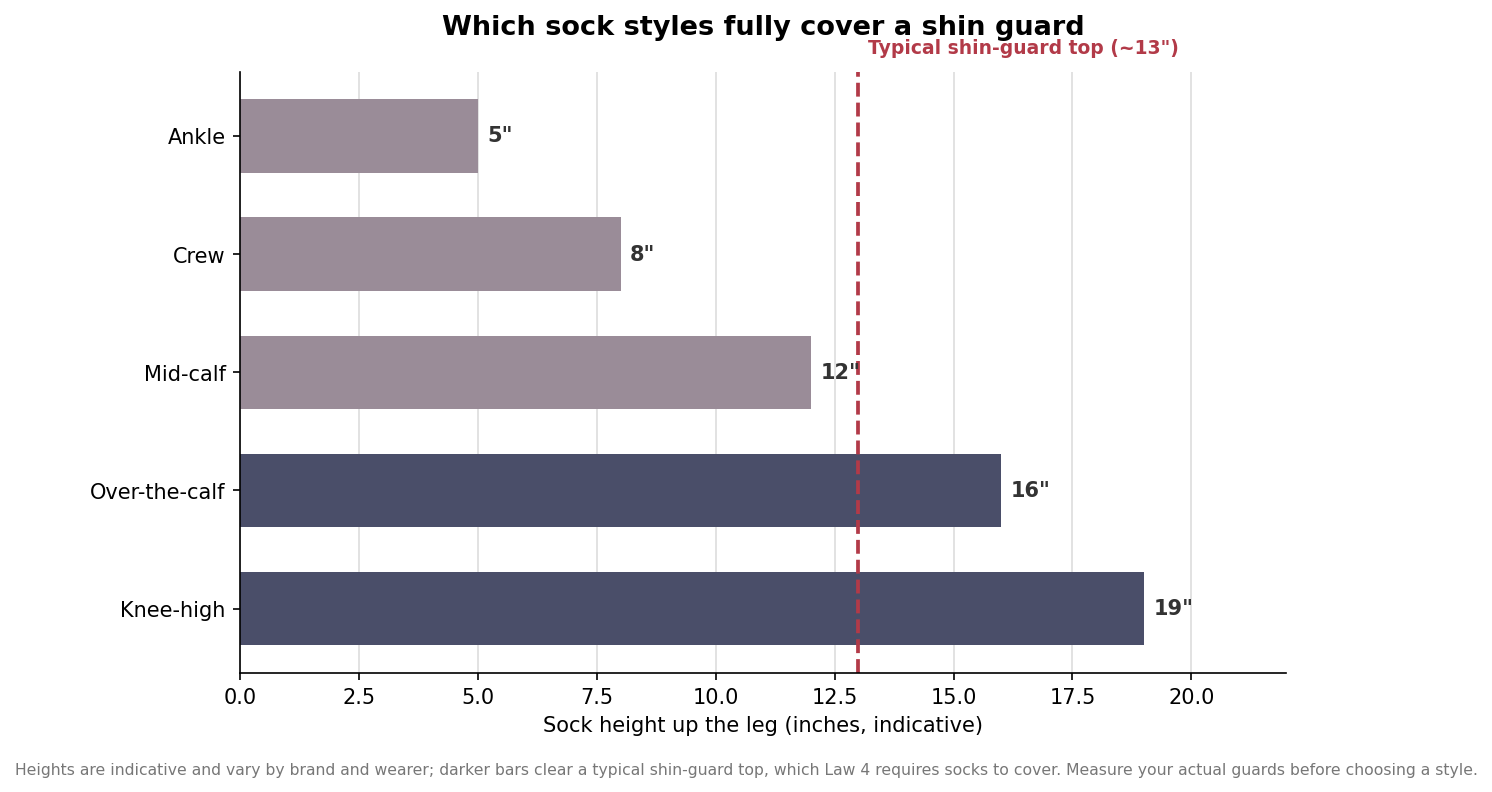
    Because the Law requires socks to cover the guard, sock height is a compliance spec, not just a look. A crew or ankle sock will not cover an adult shin guard, which is why nearly all team soccer socks are over-the-calf or knee-high. The chart below lines up common sock styles against a typical shin-guard top so you can see which styles clear it.

    Horizontal bar chart of sock style heights against a typical shin-guard top height, showing which styles cover the guard
    Only over-the-calf and knee-high socks reliably cover a typical shin guard, which Law 4 requires.

    The takeaway is to spec over-the-calf as the default for a team and to size up the height for taller players or larger guards rather than assuming one length fits everyone. Guards themselves vary: a small youth slip-in guard sits low, while an adult guard with ankle protection reaches well up the shin. Measure the guards your players actually use, then choose a sock height with an inch or two of margin above the guard’s top, because socks relax and slide down over ninety minutes. A sock that only just covers the guard when new will expose it once it has stretched and the player has run for an hour.

    Fit is a compliance issue, not just comfort

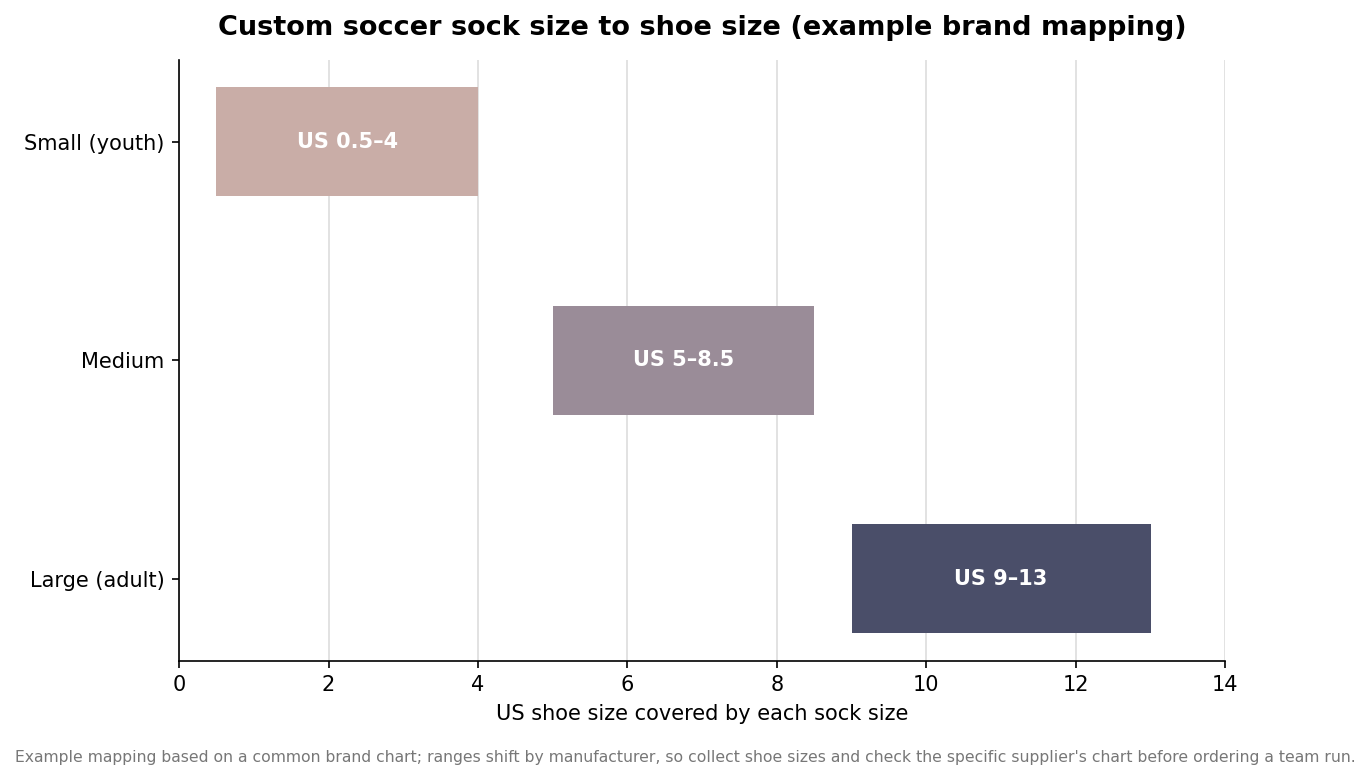
    The most common way socks fail an equipment check is not the wrong color but the wrong size. A sock that is too large slides down and uncovers the guard; a sock that is too small rolls at the top and does the same. Ordering the correct size for each player is therefore part of staying legal, and it is the single detail teams most often get wrong on a bulk order by defaulting everyone to one size. Sock size maps to shoe size, not height, and the bands vary by manufacturer, so collect shoe sizes for the squad and match them to your supplier’s chart. The example mapping below shows how the common youth, medium, and adult bands line up against US shoe sizes.

    Range bars mapping small, medium, and large soccer sock sizes to US shoe size ranges
    Sock size maps to shoe size, not height; bands shift by brand, so order from a real size spread.

    Read that as a starting point rather than a rule, because a half-size difference in where a brand draws its bands can push a player into the next sock size. When you place a custom team order, ask the supplier for their specific size chart, gather each player’s shoe size, and split the order across sizes accordingly. It is far cheaper to order two or three sizes up front than to discover on the first match day that a third of the squad is fighting socks that will not stay up over their guards.

    Speccing a custom order that passes inspection

    Pull the requirements together into the order itself. Choose a single team color and keep any logo, stripe, or number within the sock so nothing is applied externally in a contrasting color. If the design uses a contrast cuff or top band, remember that a referee reads the outermost visible layer, so keep tape and grip layers in the matching color. Default to an over-the-calf or knee-high height with margin above your players’ guards, and order a size spread built from real shoe sizes. Finally, ask for a physical sample of the finished sock, put it on over an actual shin guard, and confirm it covers the guard and holds its position before committing to the full run. A custom sock that is designed against Law 4 from the start turns the pre-match equipment check into a formality, which is exactly where you want it.

  • Your Squad Is Cutting Up the Kit Socks. Here Is the Fix.

    Walk into any changing room and there will be a bin of cut-off sock feet. It is worth understanding why before trying to ban it.

    The reason is traction, not style

    A smooth knit foot slides against a boot footbed on every change of direction.

    A grip sock underneath stops it, so players wear two and cut one.

    What it costs the club

    A destroyed kit sock a month per player, and a squad that no longer matches.

    Plus a kit check risk when a different-coloured footie shows above the boot.

    Two proper fixes

    A grip-soled team sock: silicone under the forefoot and heel, one sock, nothing cut.

    Or a made two-part system: team-colour leg sleeve with a finished hem, matching footie.

    What to check on the grip

    Coverage where the boot loads the foot, not a solid slab across the whole sole.

    And a care label that says no fabric softener, which is what kills silicone.

  • Why Your Team’s Shin Guards Start Sliding in October

    The guards get blamed, then the players, then the wash. The sock is usually the answer, and it hides in plain sight.

    Size and grip are different properties

    A knit can keep its dimensions and lose its return.

    So the sock still looks right, measures right, and no longer holds anything.

    What kills recovery

    Hot washes, tumble driers and fabric softener, in that order.

    Twenty households washing twenty ways is the real test a squad sock faces.

    What to specify instead

    Elastane content, band depth and tension, and recovery after repeated washing.

    Then a care label that actually asks for warm washes and no softener.

    The quick diagnosis

    Hold a new sock and a season-old one side by side and stretch both.

    Same length, different return, is the whole story.

  • The Complete Buyer’s Guide to Custom Soccer Socks

    A football sock has one job before it has any other, and four specifications decide whether it does it.

    Ask for elastane content

    It is the number that sets how much the tube grips the leg.

    Nobody volunteers it, and every serious knitter can tell you.

    Ask for recovery, not stretch

    Stretch on day one is easy. Returning it after fifty hot washes is the product.

    A sock that sags in November did not shrink; it stopped recovering.

    Check the band

    Depth and tension decide whether the top rolls or the leg gets marked.

    Youth sizes need a shallower band, not a smaller version of the adult one.

    Foot and leg are different garments

    Cushion the forefoot and heel. Leave the leg an even tube.

    Terry under a shin guard is bulk that lifts the guard off the leg.

    And skip cotton

    It holds sweat against the foot inside a boot for the whole match.

  • What Custom Soccer Socks Are Really Made Of: Fibers, Knit, and Grip Explained

    What Custom Soccer Socks Are Really Made Of: Fibers, Knit, and Grip Explained

    Two custom soccer socks can look identical on a mockup and feel completely different on the pitch by the second half. The print is only the surface. What decides whether a sock stays up, wicks sweat, cushions the strike zone, and survives a season of washing is the fiber blend and the way it is knitted. If you are ordering socks for a team, understanding that construction is what keeps you from buying a good-looking sock that sags and blisters.

    Here is what actually goes into a performance soccer sock, why cotton is the enemy, and how the knit and grip layers change the way the sock plays.

    The fiber blend does most of the work

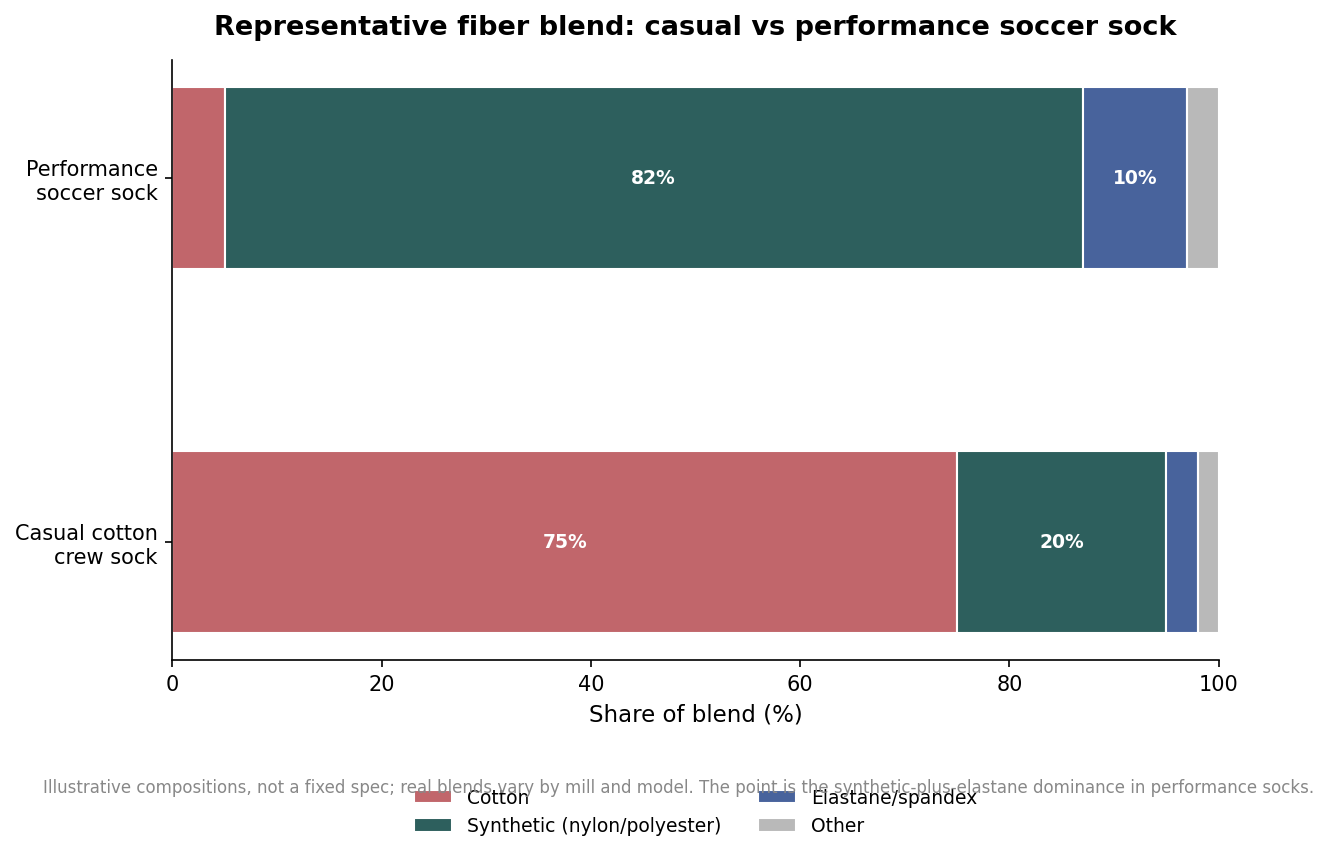
    A performance soccer sock is overwhelmingly synthetic, and that is by design. Nylon supplies durability and elastic recovery, taking the abrasion of a cleat and a shin guard while snapping back to shape instead of stretching out. Polyester handles moisture: it absorbs very little water itself, so it pulls sweat off the skin and lets it evaporate, which is the whole principle behind branded wicking yarns. Elastane, also sold as spandex or Lycra, is the small but critical component, usually under ten percent, that gives the sock its stretch and, more importantly, its hold up the calf so it does not slide down in play.

    A typical performance blend is therefore a large majority of nylon and polyester, a single-digit-to-low-double-digit share of elastane, and very little else. A casual cotton crew sock inverts that ratio, and the difference is exactly why one holds its shape through ninety minutes and the other does not.

    Stacked bar chart comparing representative fiber blends of a casual cotton sock versus a performance soccer sock
    Performance socks flip the ratio toward synthetics and elastane; blends are illustrative and vary by model.

    Why cotton loses on the field

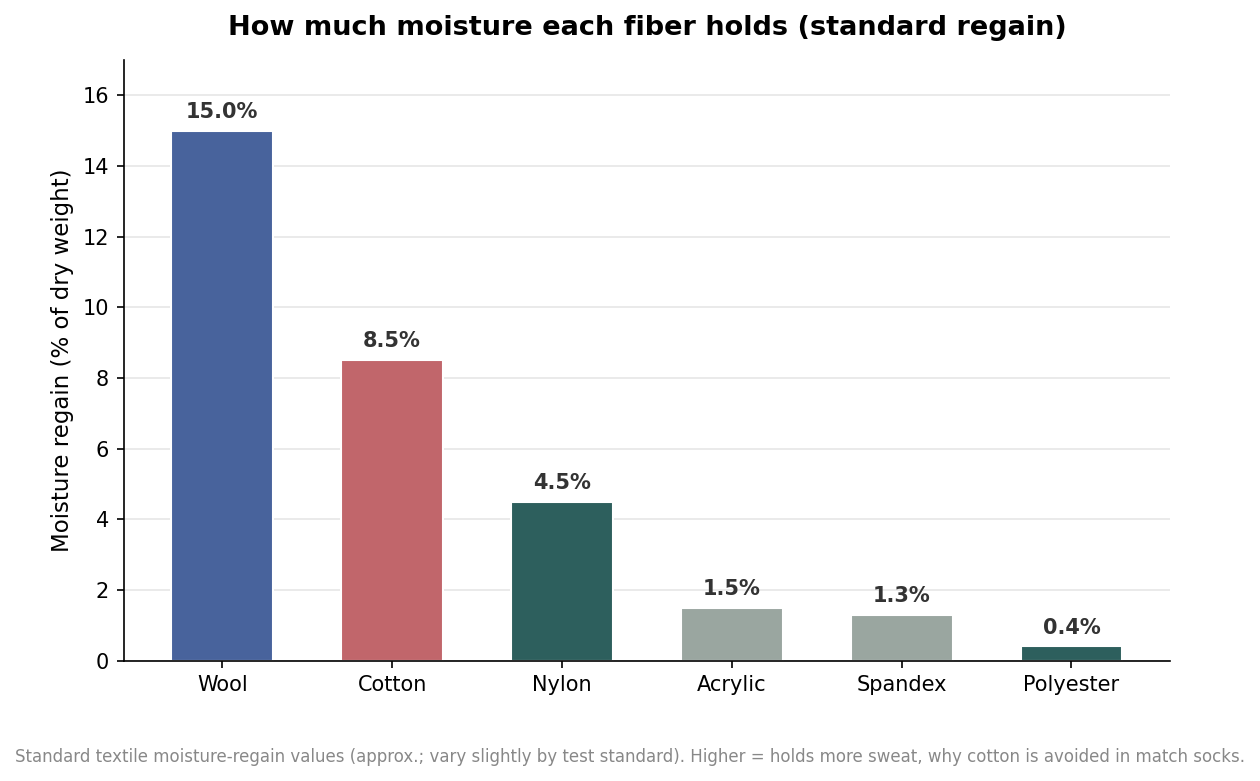
    Cotton feels soft in the store, and that is the trap. The problem is moisture regain, the amount of water a fiber holds relative to its dry weight. Cotton sits around 8.5 percent, so it soaks up sweat and holds onto it; wool is higher still. Polyester sits near 0.4 percent and simply does not, which is why a damp cotton sock stays heavy and cold while a synthetic one keeps moving moisture outward.

    That retained water is not just a comfort issue. A wet sock swells, softens, and slides against the skin, and repeated sliding under load is what raises blisters and hotspots. Cotton also loses shape as it absorbs and dries, so a cotton-heavy sock sags. For a sock that spends its life inside a hot cleat under hard cutting, the low-regain synthetics win on every count that matters.

    Bar chart of standard textile moisture regain by fiber, showing cotton and wool far higher than polyester
    Moisture regain by fiber: the higher the bar, the more sweat the fiber holds, which is why cotton is avoided.

    Knit construction: cushioning, ribbing, and hold

    Fiber choice sets the ceiling; the knit decides how much of it you feel. Better soccer socks are knitted with zones rather than a single uniform fabric. A cushioned footbed uses terry-loop pile under the sole and heel to absorb impact and reduce friction where the foot pounds the insole. The leg is often a ribbed knit, which flexes to grip the calf and resist slipping down. A reinforced heel and toe add extra yarn at the two spots that wear through first, and mesh or open-knit panels across the instep and top of the foot vent heat.

    Some socks add graduated compression through the leg, using tighter elastane tension to support the calf. It is a real feature, but a modest one for most amateur play, and it raises cost, so it is worth specifying only if your players actually want it. When you request a proof, ask where the cushioning sits and how the leg is knitted, because those choices affect feel far more than the thread count on the logo.

    The grip-sock layer

    The fastest-growing change in team socks is the grip sock. These carry silicone or rubber pads printed onto the sole, and sometimes the sides, that grip the inside of the cleat and stop the foot sliding within the shoe during sprints, cuts, and hard stops. Reducing that internal slippage improves the efficiency of push-off and cutting and cuts down on the blisters that slippage causes. The pads do not make anyone faster or more skilled; they remove a small inefficiency in the gear.

    Because grip socks are usually thinner and shorter than a full team sock, many players wear them underneath, then pull a cut or footless team sock over the top so the club colors still show for the referee and the camera. That two-sock setup is now common enough that plenty of teams order a footless or pre-cut team sock specifically to pair with a grip sock underneath. Grip pads also wear down; a well-used pair typically holds its grip for a few months of regular play before the silicone smooths out and needs replacing, so treat them as a consumable rather than a season-long item.

    Speccing the blend for your team

    Work from use back to fiber. For match and training socks that need to stay up and stay dry, specify a nylon-and-polyester majority with elastane for hold, and steer away from any blend where cotton is more than a token share. Decide whether you want a cushioned footbed, which most players appreciate and which adds only modestly to cost, and whether compression is worth the premium for your level, which for most amateur sides it is not.

    If your players are moving to grip socks, plan the system rather than the single item: a grip sock underneath and a footless or cut team sock over it, ordered together so the colors and the traction both work. Ask your supplier to confirm the blend percentages and the knit zones in writing before you approve the run, because those numbers, not the artwork, are what determine how the sock performs once the whistle blows.

  • How to Spec Custom Soccer Socks for a Team

    How to Spec Custom Soccer Socks for a Team

    A soccer sock looks like a simple garment, but it is one of the few pieces of kit that has to stay put through ninety minutes of sprinting, cover a shin guard without bunching, and survive an industrial wash dozens of times a season. When you order custom soccer socks for a club or team, most of the disappointment traces back to decisions made before the design was ever approved: the wrong yarn blend, a printed logo where a knitted one belonged, or a size run that leaves half the under-eights swimming in fabric. This guide walks through the specifications that actually matter, so you can hand a manufacturer a brief that produces socks players want to wear.

    Start with the yarn blend, not the color

    The blend decides how the sock performs long before anyone notices the crest. For competitive play, a polyester-dominant blend in the range of 65 to 85 percent is the standard, because polyester wicks moisture, dries quickly, resists abrasion, and holds color through repeated washing. A representative performance recipe is roughly 65 percent polyester for moisture management, around 25 percent cotton for next-to-skin comfort, and about 10 percent elastane for stretch and recovery. Cotton-dominant blends of 65 to 75 percent feel softer in the hand but absorb sweat, dry slowly, and fade faster under UV and heat, which makes them better suited to leisure socks than match socks. If you are speccing for a hot climate or heavy training loads, ask about polypropylene content, which manages moisture and temperature better than cotton.

    The detail that gets skipped is elastic recovery. A cuff that loses 15 to 20 percent of its recovery after around twenty wash cycles is at the point where socks start sliding down mid-match. Specify a double-welt cuff with elastane knitted into the fabric rather than a separate elastic band sewn on top, and you buy yourself far more than a single season of grip.

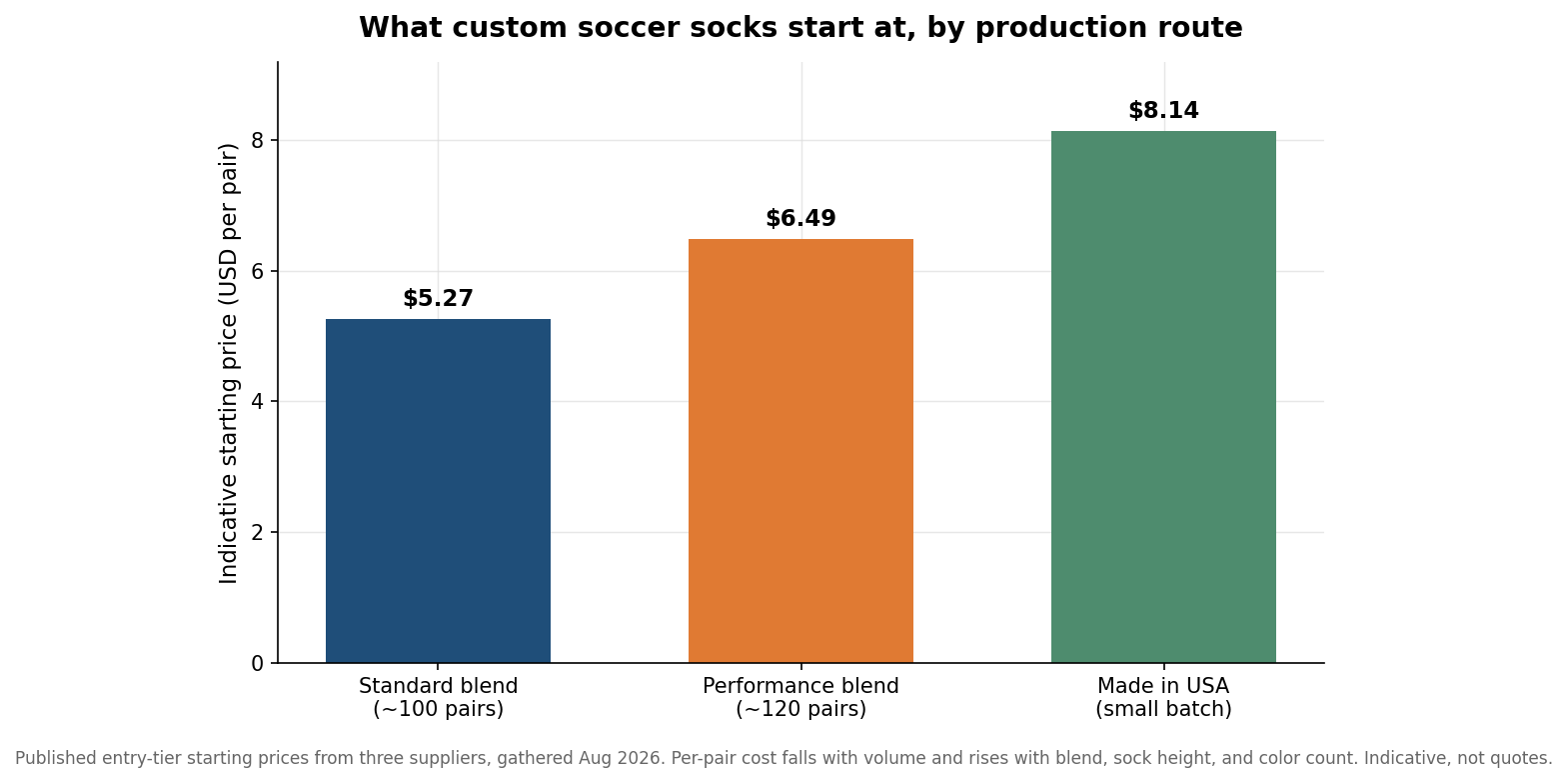
    Bar chart of indicative starting price per pair for custom soccer socks by production route
    Entry-tier starting prices from three suppliers; per-pair cost falls with volume.

    Decide how the design goes on: knit-in versus sublimated

    This is the single choice that most affects how the socks look after a season of washing. Knit-in decoration, sometimes called jacquard knitting, builds the pattern into the fabric as the sock is made on the machine. Stripes, color blocks, numbers, and simple logos become part of the structure, so they do not crack, peel, or fade; engineered stripes routinely outlast the sock itself. The trade-off is resolution, because fine gradients and photographic detail are hard to knit and every added color raises complexity. Sublimated printing dyes a full-color design into the surface and can reproduce almost anything, including gradients and intricate crests, but printed stripes and logos tend to crack and fade after a season of hard use, and sublimation usually carries a higher minimum order. A practical rule: knit the elements that must survive, such as team stripes, a sponsor block, and numbers, and reserve sublimation for kits where a complex, full-color graphic is the entire point.

    Get length, cushioning, and fit right

    Match socks are traditionally over-the-calf so they can cover a shin guard and be held up under the knee. Expect roughly 14 to 16 inches from ankle to cuff opening, or about 18 to 22 inches measured from the heel, depending on size. Look for reinforced, higher-density knitting at the toe box and heel, where socks wear through first, and terry-loop cushioning under the ball of the foot and heel to pad the impact zones without making the whole sock hot.

    Size by shoe size, not by age, and give the manufacturer a clean size run. A workable four-tier structure is youth small, youth large, adult medium, and adult large, mapped to U.S. shoe-size bands, with adult medium landing around a 6 to 10 and adult large around a 10 to 13. Collect actual shoe sizes from your roster before you commit quantities, because guessing from age brackets is the fastest route to an awkward re-order.

    One trend worth planning for: many players now cut the foot off the team sock and wear a separate grip sock underneath, an ankle-height sock with silicone pads on the sole, using the team sock as a leg sleeve over the shin guard. If your players already do this, spec the team sock knowing its foot may be sacrificed, and consider offering a matching grip sock so the team still looks uniform on the pitch.

    Plan quantities, price, and lead time together

    Custom socks are made to order, so minimums, price, and calendar are linked rather than separate line items. Typical minimums run around 100 to 120 pairs per design for knit-in work, with sublimated designs often starting nearer 200 pairs because of print setup. Indicative starting prices sit in the neighborhood of $5 to $8 per pair at entry quantities, dropping per pair as volume rises and climbing for domestic manufacturing or premium blends. Treat any single number as a starting point, since blend, sock height, and color count all move it. Because per-pair cost falls when you consolidate designs, resist the urge to spec a different sock for every age group when one shared design will do the job.

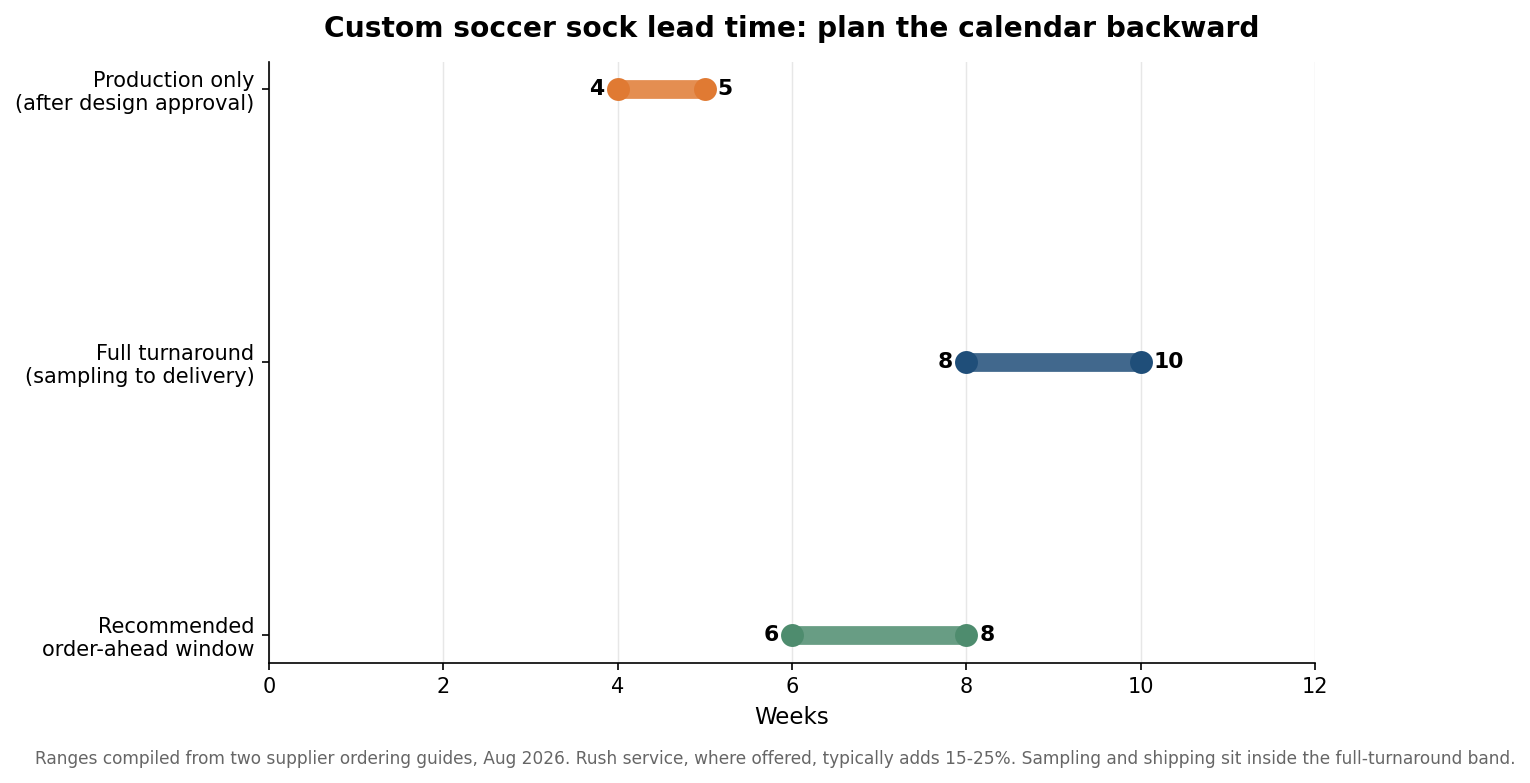
    Range chart of custom soccer sock turnaround times in weeks from design approval to delivery
    Plan the calendar backward from your first fixture; rush service adds 15-25%.

    Lead time is where teams get caught out. Production alone commonly runs four to five weeks after final design approval, and full turnaround from approval to delivered boxes is often quoted at eight to ten weeks once sampling and shipping are folded in. Rush service, where it is offered, typically adds 15 to 25 percent. Work backward from your first competitive fixture and start the design conversation six to eight weeks ahead at a minimum, and earlier still if you need a physical sample approved before the full run.

    The brief to hand your manufacturer

    Before you approve a sample, put the specification in writing: the exact yarn blend and percentages, the decoration method for each design element, the sock height, the cushioning and reinforcement zones, the size run with quantities per tier, and the delivery date you are working toward. Ask for a physical pre-production sample and wash it five to ten times before you sign off, because a sock that looks perfect out of the bag but loses its cuff or cracks its print after a month will cost you a re-order and a season of complaints. Specifying carefully once is far cheaper than discovering the gaps on the pitch.