Most problems with a team sock order are not about color or logo placement — they are about size. A box of custom socks that photographs beautifully is useless if half the squad is swimming in them or straining the cuff over a shin guard. The good news is that soccer socks are sized to be forgiving: each knitted size stretches across several shoe sizes, so a whole club can usually be kitted in two or three bands. The trick is knowing how those bands map to feet, and ordering to the specific maker’s chart rather than a generic guess.
This guide covers how sock sizing actually works, how to read a size chart by shoe size, how to handle mixed or international rosters, and how to size a full team quickly without measuring every foot.
How soccer sock sizing works
Unlike a shoe, a soccer sock is not cut to a single foot length. It is knitted from stretchy yarn and designed to pull up over the calf to hold a shin guard, which means one size deliberately spans a wide range of shoe sizes. That is why you will almost never see socks sold in single shoe sizes; instead they come in a handful of bands — commonly a small, medium, and large — each of which comfortably fits players several shoe sizes apart. The practical upside is that you do not need a different sock for every foot on the roster. A youth team often fits entirely in one or two bands, and a senior squad usually splits across just two.
Fit still matters within that stretch. A sock sized too small will feel tight at the cuff, slide down as it fights to stay up, and wear through faster at the heel and toe. A sock sized too large bunches inside the boot and bags at the ankle. The stretch buys you tolerance, not immunity, so you still want each player in the band their shoe size actually falls in.
Reading a size chart by shoe size
The cleanest way to order is by shoe size, because every player already knows theirs. A typical three-band chart maps roughly to US shoe sizes as a small covering the youth range, a medium bridging older youth and smaller adult feet, and a large covering adult sizes. Because the bands are built to overlap, a player who sits right on a boundary can usually go either way, and the sensible tiebreaker is to size up: the larger band gives more length to cover the shin guard and puts less strain on the cuff.
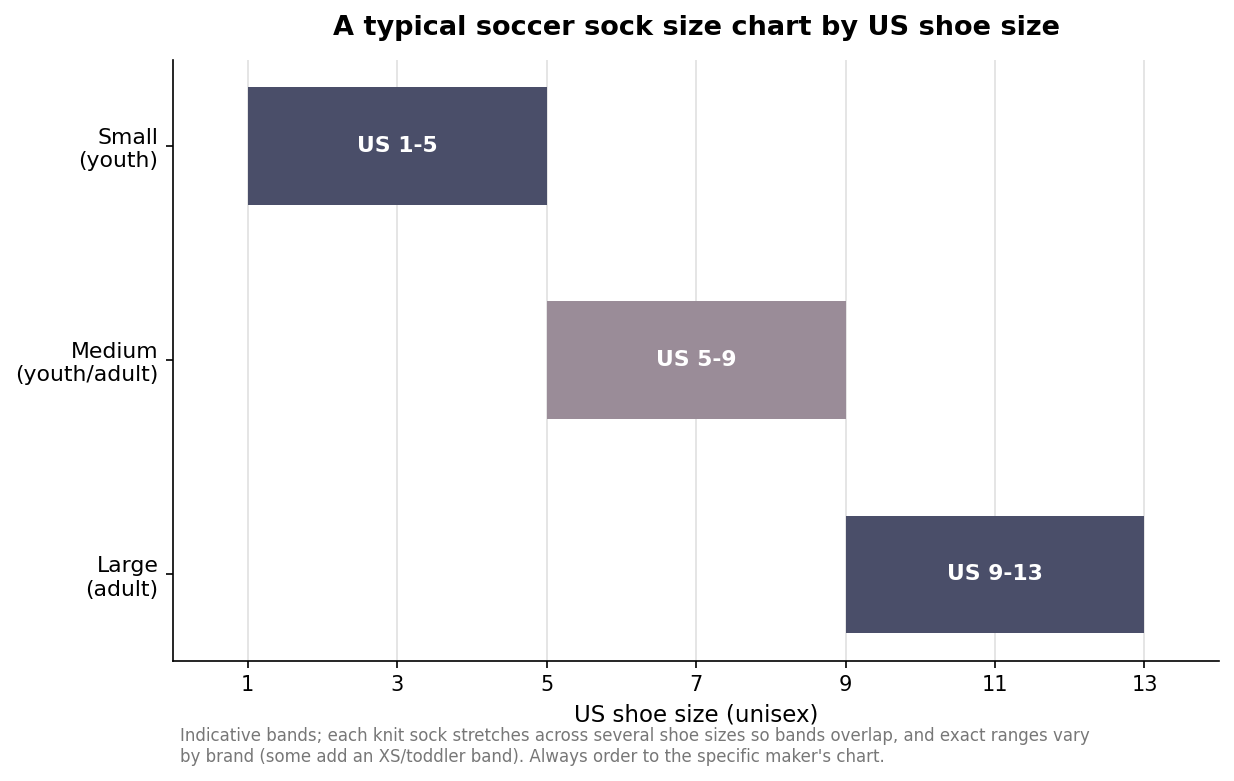
The important caveat is that these ranges are indicative and vary by manufacturer. Some brands run a four-band system that adds an extra small or toddler size and shifts the adult boundary by half a size or so, which means a “medium” from one maker is not identical to a “medium” from another. Never assume the bands are universal. Pull the actual size chart for the exact sock you are ordering, match each shoe size to that chart, and you will avoid the most common cause of a mis-sized team order.
Mixed and international rosters
Two complications trip up team orders. The first is that women’s and men’s US shoe sizing are offset — women’s sizes run roughly one and a half sizes higher than men’s for the same foot — so a mixed-gender roster collected as raw shoe numbers needs that offset applied before it maps cleanly onto a unisex sock chart. The second is that many sock charts, especially from European brands, are printed in EU or UK sizes, while your players know their feet in US numbers.
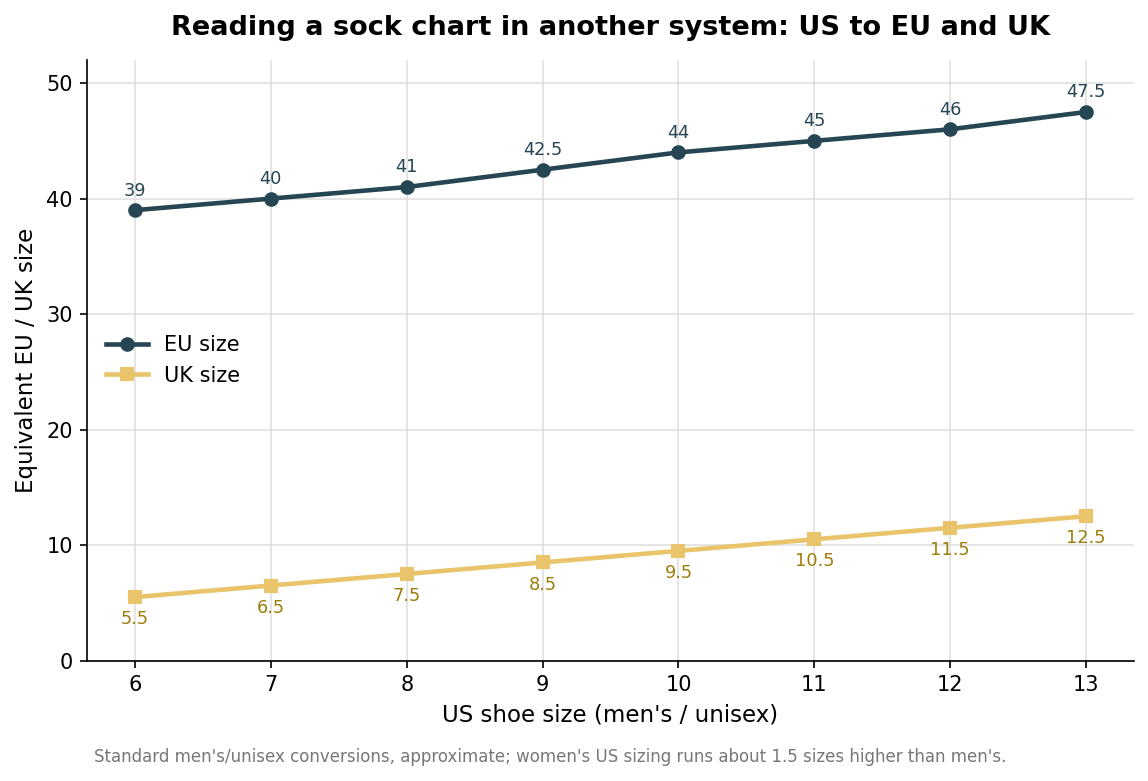
Keeping a simple conversion on hand removes the guesswork. A US men’s 9 is about an EU 42.5 and a UK 8.5; a US 11 is roughly an EU 45 and a UK 10.5. If you collect the roster in US sizes but the sock chart is in EU, convert first and then place each player into the band — do not eyeball it, because a one-size slip at the boundary is exactly where cuffs end up too tight. When in doubt, contact the supplier with your roster’s shoe sizes and let them map it to their own chart.
Sizing a whole team without measuring feet
You do not need a tape measure or a fitting session. Collect each player’s normal shoe size, apply the women’s-to-men’s offset where needed, convert to the chart’s system if it differs, and tally how many fall into each band. For most squads that produces a clean split — for example a cluster of youths in the small and a cluster of adults in the medium and large — and you order to those counts plus a few spares in the busiest band.
Handle the edge cases deliberately. A player on a boundary sizes up. A player who wears a bulky shin guard or likes a tighter, more compressive feel also leans to the larger band for length or the snugger band for grip, depending on which they prefer — ask them. And if your socks are a footless or grip style rather than a full sock, check the maker’s chart specifically, because those constructions often size differently from a standard knitted sock. A short call to confirm one or two ambiguous players is far cheaper than reordering a batch.
Getting length and coverage right
Length is the other half of fit. Traditional team socks are long, pulling up over the calf to just below the knee so they fully cover the shin guard, which is what league kit rules generally expect. Shorter constructions exist — crew, quarter, and ankle lengths for training or off-pitch wear — but for match kit the over-the-calf length is the default, and it is what makes the stretch-to-fit sizing work, since the sock relies on that height to stay up. When you specify the order, confirm both the size band and the length term so the socks arrive tall enough to do their job.
Get these few things right — order by shoe size, use the exact chart, apply the gender and international offsets, and size up at the boundaries — and a team sock order becomes routine. The stretch in the knit is generous enough to forgive small misjudgments, but it works best when you meet it halfway with sizes that actually match the feet wearing them.