A soccer sock looks like a simple garment, but it is one of the few pieces of kit that has to stay put through ninety minutes of sprinting, cover a shin guard without bunching, and survive an industrial wash dozens of times a season. When you order custom soccer socks for a club or team, most of the disappointment traces back to decisions made before the design was ever approved: the wrong yarn blend, a printed logo where a knitted one belonged, or a size run that leaves half the under-eights swimming in fabric. This guide walks through the specifications that actually matter, so you can hand a manufacturer a brief that produces socks players want to wear.
Start with the yarn blend, not the color
The blend decides how the sock performs long before anyone notices the crest. For competitive play, a polyester-dominant blend in the range of 65 to 85 percent is the standard, because polyester wicks moisture, dries quickly, resists abrasion, and holds color through repeated washing. A representative performance recipe is roughly 65 percent polyester for moisture management, around 25 percent cotton for next-to-skin comfort, and about 10 percent elastane for stretch and recovery. Cotton-dominant blends of 65 to 75 percent feel softer in the hand but absorb sweat, dry slowly, and fade faster under UV and heat, which makes them better suited to leisure socks than match socks. If you are speccing for a hot climate or heavy training loads, ask about polypropylene content, which manages moisture and temperature better than cotton.
The detail that gets skipped is elastic recovery. A cuff that loses 15 to 20 percent of its recovery after around twenty wash cycles is at the point where socks start sliding down mid-match. Specify a double-welt cuff with elastane knitted into the fabric rather than a separate elastic band sewn on top, and you buy yourself far more than a single season of grip.
Decide how the design goes on: knit-in versus sublimated
This is the single choice that most affects how the socks look after a season of washing. Knit-in decoration, sometimes called jacquard knitting, builds the pattern into the fabric as the sock is made on the machine. Stripes, color blocks, numbers, and simple logos become part of the structure, so they do not crack, peel, or fade; engineered stripes routinely outlast the sock itself. The trade-off is resolution, because fine gradients and photographic detail are hard to knit and every added color raises complexity. Sublimated printing dyes a full-color design into the surface and can reproduce almost anything, including gradients and intricate crests, but printed stripes and logos tend to crack and fade after a season of hard use, and sublimation usually carries a higher minimum order. A practical rule: knit the elements that must survive, such as team stripes, a sponsor block, and numbers, and reserve sublimation for kits where a complex, full-color graphic is the entire point.
Get length, cushioning, and fit right
Match socks are traditionally over-the-calf so they can cover a shin guard and be held up under the knee. Expect roughly 14 to 16 inches from ankle to cuff opening, or about 18 to 22 inches measured from the heel, depending on size. Look for reinforced, higher-density knitting at the toe box and heel, where socks wear through first, and terry-loop cushioning under the ball of the foot and heel to pad the impact zones without making the whole sock hot.
Size by shoe size, not by age, and give the manufacturer a clean size run. A workable four-tier structure is youth small, youth large, adult medium, and adult large, mapped to U.S. shoe-size bands, with adult medium landing around a 6 to 10 and adult large around a 10 to 13. Collect actual shoe sizes from your roster before you commit quantities, because guessing from age brackets is the fastest route to an awkward re-order.
One trend worth planning for: many players now cut the foot off the team sock and wear a separate grip sock underneath, an ankle-height sock with silicone pads on the sole, using the team sock as a leg sleeve over the shin guard. If your players already do this, spec the team sock knowing its foot may be sacrificed, and consider offering a matching grip sock so the team still looks uniform on the pitch.
Plan quantities, price, and lead time together
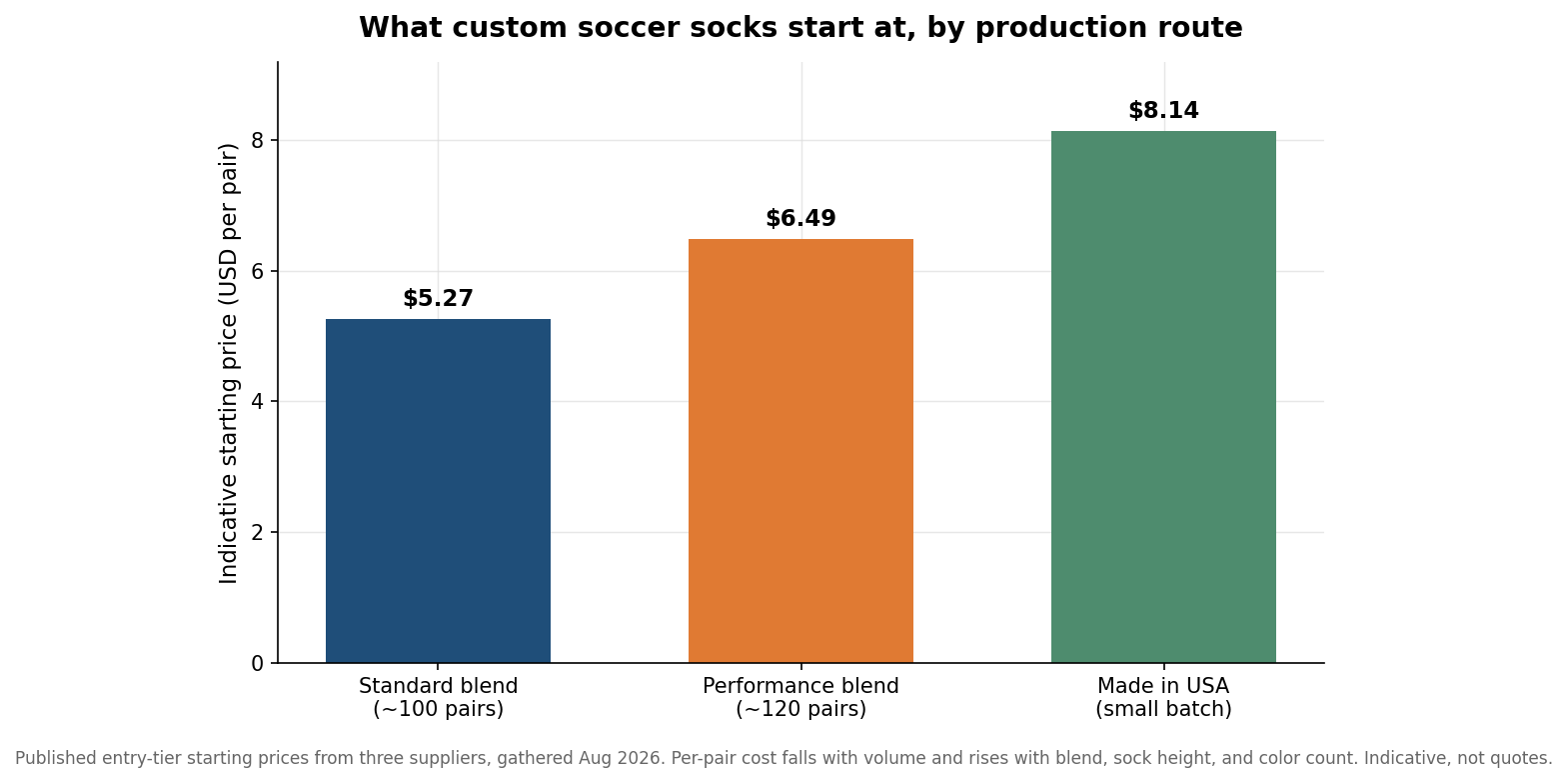
Custom socks are made to order, so minimums, price, and calendar are linked rather than separate line items. Typical minimums run around 100 to 120 pairs per design for knit-in work, with sublimated designs often starting nearer 200 pairs because of print setup. Indicative starting prices sit in the neighborhood of $5 to $8 per pair at entry quantities, dropping per pair as volume rises and climbing for domestic manufacturing or premium blends. Treat any single number as a starting point, since blend, sock height, and color count all move it. Because per-pair cost falls when you consolidate designs, resist the urge to spec a different sock for every age group when one shared design will do the job.
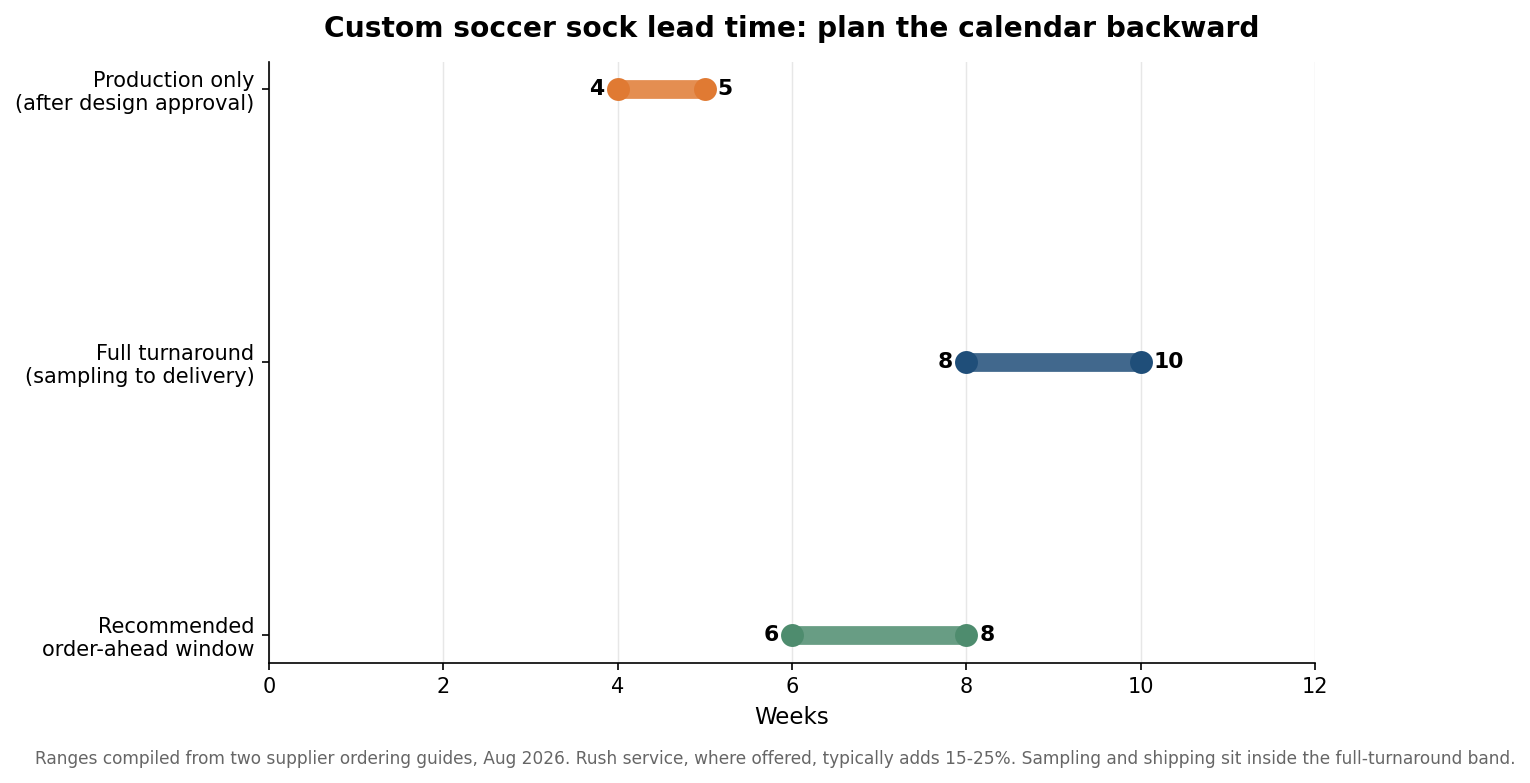
Lead time is where teams get caught out. Production alone commonly runs four to five weeks after final design approval, and full turnaround from approval to delivered boxes is often quoted at eight to ten weeks once sampling and shipping are folded in. Rush service, where it is offered, typically adds 15 to 25 percent. Work backward from your first competitive fixture and start the design conversation six to eight weeks ahead at a minimum, and earlier still if you need a physical sample approved before the full run.
The brief to hand your manufacturer
Before you approve a sample, put the specification in writing: the exact yarn blend and percentages, the decoration method for each design element, the sock height, the cushioning and reinforcement zones, the size run with quantities per tier, and the delivery date you are working toward. Ask for a physical pre-production sample and wash it five to ten times before you sign off, because a sock that looks perfect out of the bag but loses its cuff or cracks its print after a month will cost you a re-order and a season of complaints. Specifying carefully once is far cheaper than discovering the gaps on the pitch.