Custom team socks are the easiest piece of kit to get right and a surprisingly common reason a player gets sent back to the touchline to fix their equipment. The rules that govern socks are short, but they trip up teams every season, usually over grip socks, tape color, or a sock that no longer covers the shin guard by the second half. If you are ordering custom socks for a squad, it pays to design and size them so they pass an equipment check without a second thought. Here is what the Laws of the Game actually require, and how to spec your order to stay on the right side of them.
What the Laws actually say about socks
The governing text is Law 4, the players’ equipment. It is less about style than most people assume and more about two specific points. First, shin guards are compulsory and, in the words of the Law, must “be covered by the socks.” A guard poking out above a sagging sock is a technical violation, not a fashion choice. Second, and the one that catches teams out most, is the color rule for anything added to the sock. Law 4 states that “tape or any material applied or worn externally must be the same colour as that part of the sock it is applied to or covers.” That single sentence governs sock tape, straps, and, by direct extension, the grip socks that have taken over the game.
Notice what the Law does not say. There is no separate clause demanding that every teammate wear identically colored socks the way undershorts must match shorts, though many competitions impose their own uniformity rules on top of the Law. The safe assumption is that your league expects a consistent team sock, so order one color for the squad and treat any competition-specific rule as an addition, not a replacement, to Law 4.
The grip-sock problem, and the compliant way to handle it
Grip socks are legal, but the way players wear them is where trouble starts. Because Law 4 requires that anything worn externally over the sock match the color it covers, a player who pulls a black grip sock over a red team sock is out of compliance the moment the grip sock shows. Referees do enforce this, and youth competitions tend to be stricter than casual adult leagues. There are two clean solutions. The player can wear the grip sock underneath the team sock, cutting the foot out of the team sock or wearing a footless team sleeve over it so the visible layer is entirely team color. Alternatively, you order the team socks in a design that already integrates grip, so there is no second layer to police at all.
For a custom order, the second route is the one that removes the argument entirely. Speccing internal grip zones into the team sock, or supplying grip socks in the exact team color, means the visible sock is compliant by construction and no player has to remember a workaround on match day. If you go the layered route instead, buy the grip socks in the team color and make that part of the kit rule you hand to parents and players.
Covering the shin guard is a question of height
Because the Law requires socks to cover the guard, sock height is a compliance spec, not just a look. A crew or ankle sock will not cover an adult shin guard, which is why nearly all team soccer socks are over-the-calf or knee-high. The chart below lines up common sock styles against a typical shin-guard top so you can see which styles clear it.
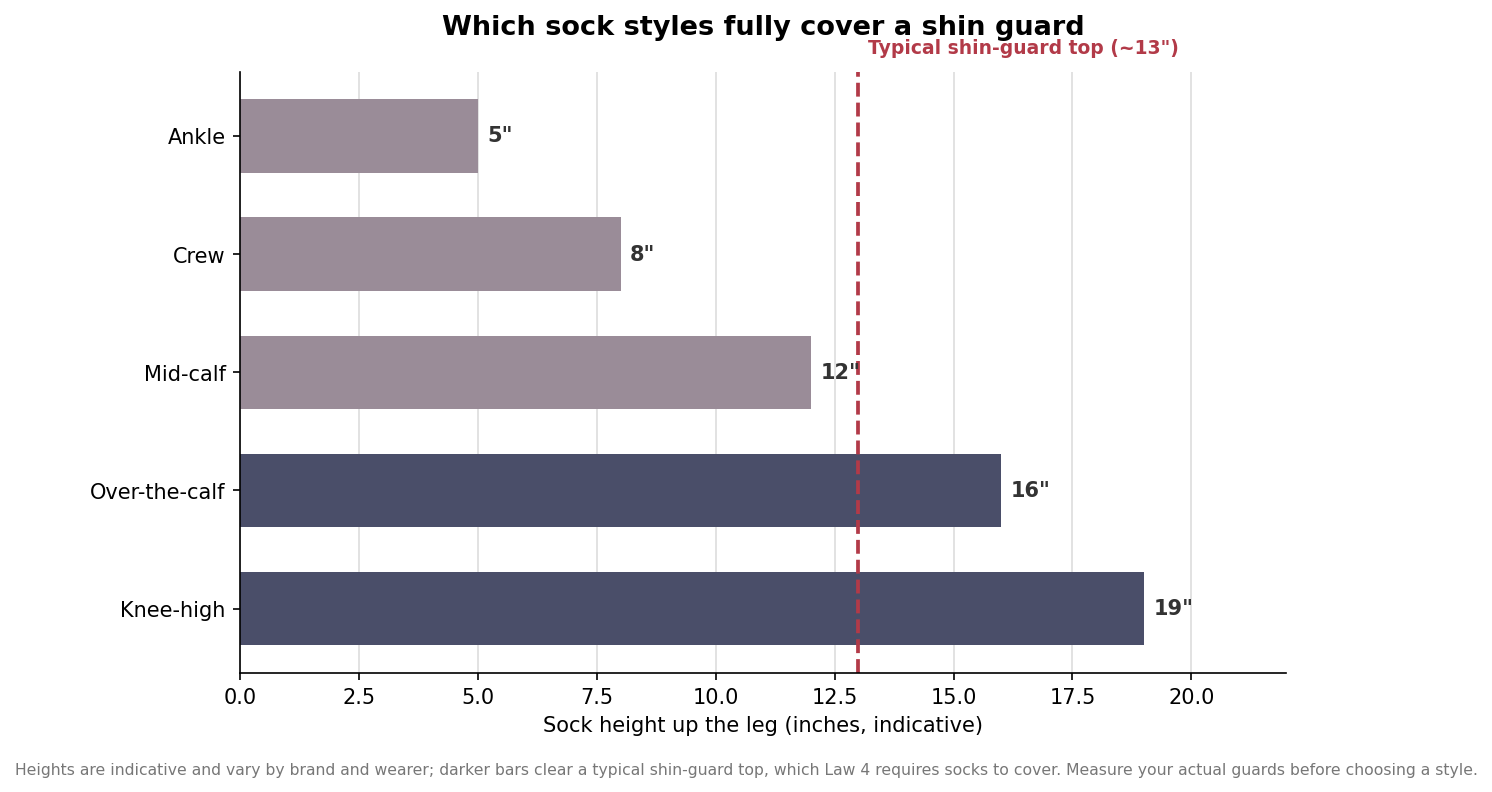
The takeaway is to spec over-the-calf as the default for a team and to size up the height for taller players or larger guards rather than assuming one length fits everyone. Guards themselves vary: a small youth slip-in guard sits low, while an adult guard with ankle protection reaches well up the shin. Measure the guards your players actually use, then choose a sock height with an inch or two of margin above the guard’s top, because socks relax and slide down over ninety minutes. A sock that only just covers the guard when new will expose it once it has stretched and the player has run for an hour.
Fit is a compliance issue, not just comfort
The most common way socks fail an equipment check is not the wrong color but the wrong size. A sock that is too large slides down and uncovers the guard; a sock that is too small rolls at the top and does the same. Ordering the correct size for each player is therefore part of staying legal, and it is the single detail teams most often get wrong on a bulk order by defaulting everyone to one size. Sock size maps to shoe size, not height, and the bands vary by manufacturer, so collect shoe sizes for the squad and match them to your supplier’s chart. The example mapping below shows how the common youth, medium, and adult bands line up against US shoe sizes.
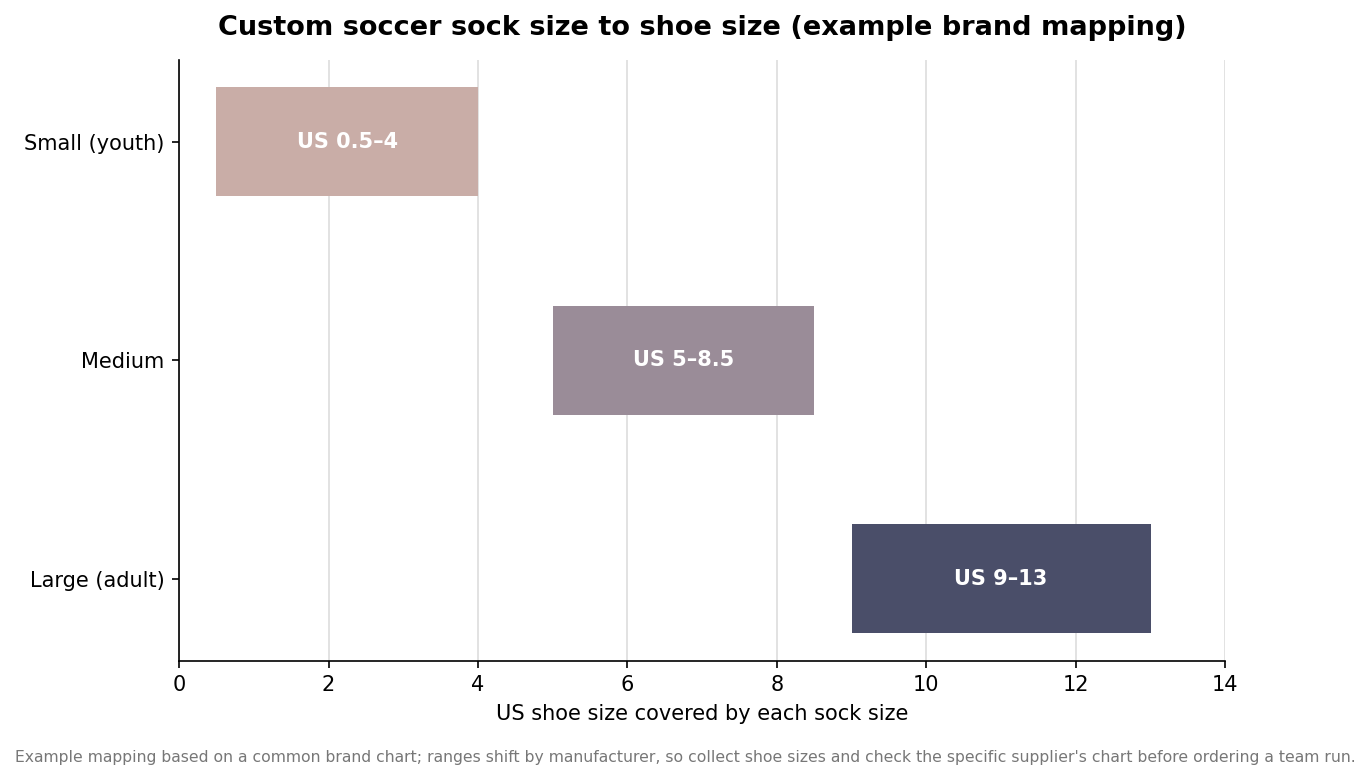
Read that as a starting point rather than a rule, because a half-size difference in where a brand draws its bands can push a player into the next sock size. When you place a custom team order, ask the supplier for their specific size chart, gather each player’s shoe size, and split the order across sizes accordingly. It is far cheaper to order two or three sizes up front than to discover on the first match day that a third of the squad is fighting socks that will not stay up over their guards.
Speccing a custom order that passes inspection
Pull the requirements together into the order itself. Choose a single team color and keep any logo, stripe, or number within the sock so nothing is applied externally in a contrasting color. If the design uses a contrast cuff or top band, remember that a referee reads the outermost visible layer, so keep tape and grip layers in the matching color. Default to an over-the-calf or knee-high height with margin above your players’ guards, and order a size spread built from real shoe sizes. Finally, ask for a physical sample of the finished sock, put it on over an actual shin guard, and confirm it covers the guard and holds its position before committing to the full run. A custom sock that is designed against Law 4 from the start turns the pre-match equipment check into a formality, which is exactly where you want it.