Two custom soccer socks can look identical on a mockup and feel completely different on the pitch by the second half. The print is only the surface. What decides whether a sock stays up, wicks sweat, cushions the strike zone, and survives a season of washing is the fiber blend and the way it is knitted. If you are ordering socks for a team, understanding that construction is what keeps you from buying a good-looking sock that sags and blisters.
Here is what actually goes into a performance soccer sock, why cotton is the enemy, and how the knit and grip layers change the way the sock plays.
The fiber blend does most of the work
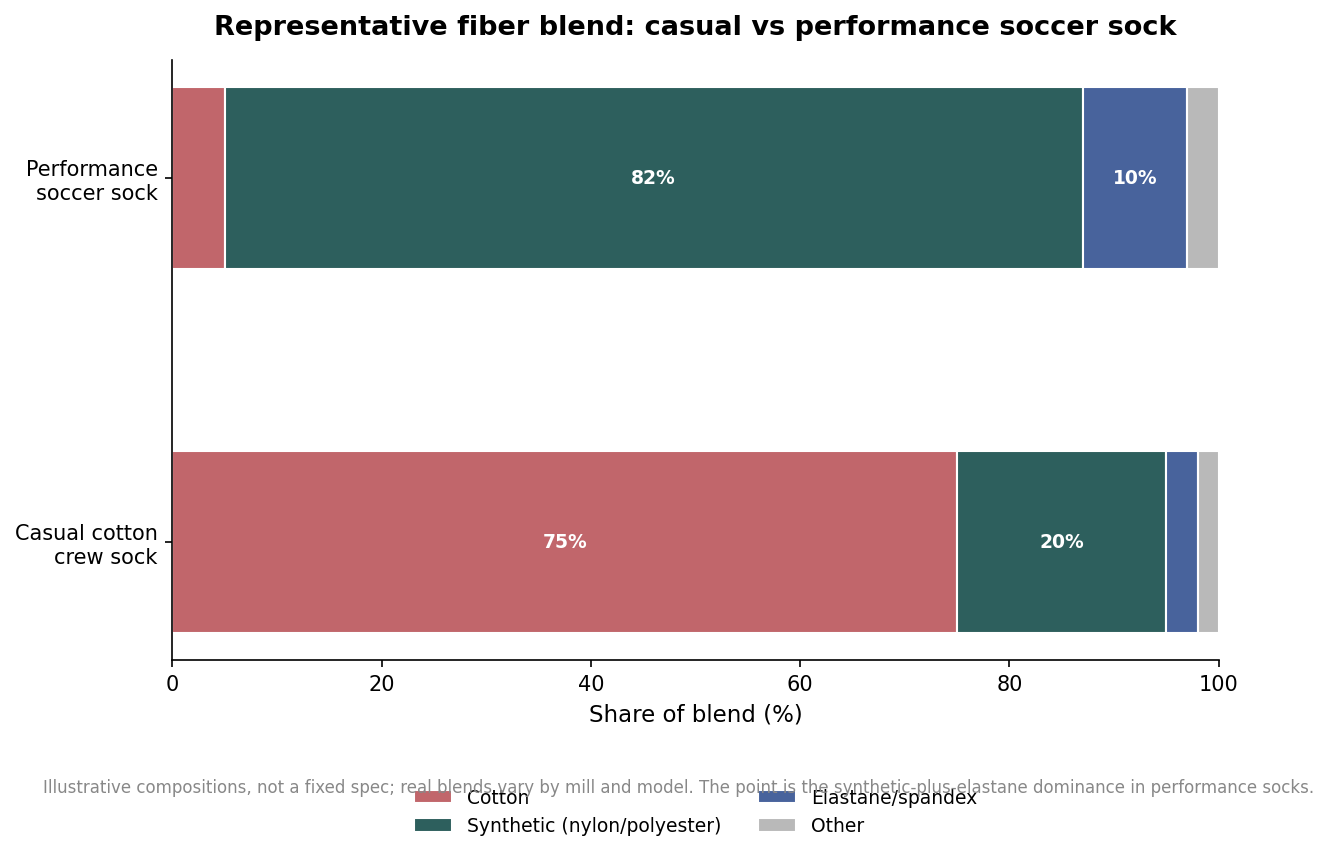
A performance soccer sock is overwhelmingly synthetic, and that is by design. Nylon supplies durability and elastic recovery, taking the abrasion of a cleat and a shin guard while snapping back to shape instead of stretching out. Polyester handles moisture: it absorbs very little water itself, so it pulls sweat off the skin and lets it evaporate, which is the whole principle behind branded wicking yarns. Elastane, also sold as spandex or Lycra, is the small but critical component, usually under ten percent, that gives the sock its stretch and, more importantly, its hold up the calf so it does not slide down in play.
A typical performance blend is therefore a large majority of nylon and polyester, a single-digit-to-low-double-digit share of elastane, and very little else. A casual cotton crew sock inverts that ratio, and the difference is exactly why one holds its shape through ninety minutes and the other does not.
Why cotton loses on the field
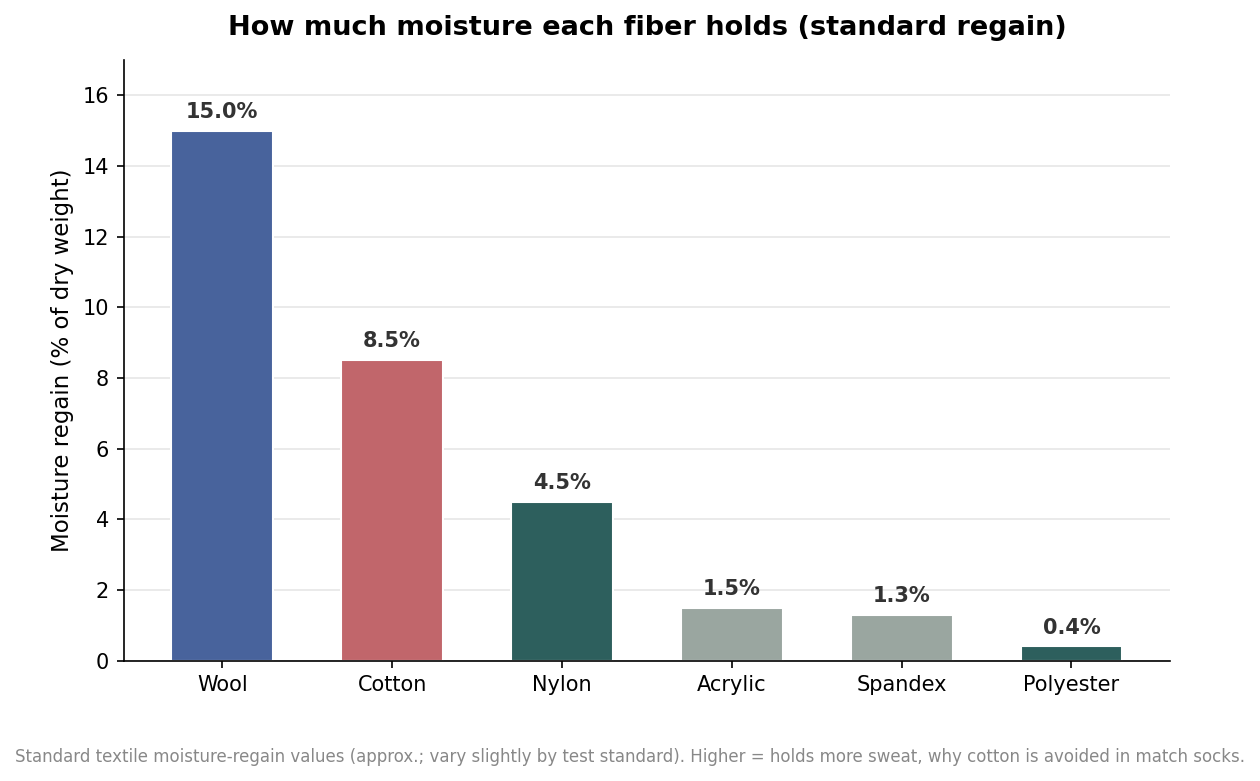
Cotton feels soft in the store, and that is the trap. The problem is moisture regain, the amount of water a fiber holds relative to its dry weight. Cotton sits around 8.5 percent, so it soaks up sweat and holds onto it; wool is higher still. Polyester sits near 0.4 percent and simply does not, which is why a damp cotton sock stays heavy and cold while a synthetic one keeps moving moisture outward.
That retained water is not just a comfort issue. A wet sock swells, softens, and slides against the skin, and repeated sliding under load is what raises blisters and hotspots. Cotton also loses shape as it absorbs and dries, so a cotton-heavy sock sags. For a sock that spends its life inside a hot cleat under hard cutting, the low-regain synthetics win on every count that matters.
Knit construction: cushioning, ribbing, and hold
Fiber choice sets the ceiling; the knit decides how much of it you feel. Better soccer socks are knitted with zones rather than a single uniform fabric. A cushioned footbed uses terry-loop pile under the sole and heel to absorb impact and reduce friction where the foot pounds the insole. The leg is often a ribbed knit, which flexes to grip the calf and resist slipping down. A reinforced heel and toe add extra yarn at the two spots that wear through first, and mesh or open-knit panels across the instep and top of the foot vent heat.
Some socks add graduated compression through the leg, using tighter elastane tension to support the calf. It is a real feature, but a modest one for most amateur play, and it raises cost, so it is worth specifying only if your players actually want it. When you request a proof, ask where the cushioning sits and how the leg is knitted, because those choices affect feel far more than the thread count on the logo.
The grip-sock layer
The fastest-growing change in team socks is the grip sock. These carry silicone or rubber pads printed onto the sole, and sometimes the sides, that grip the inside of the cleat and stop the foot sliding within the shoe during sprints, cuts, and hard stops. Reducing that internal slippage improves the efficiency of push-off and cutting and cuts down on the blisters that slippage causes. The pads do not make anyone faster or more skilled; they remove a small inefficiency in the gear.
Because grip socks are usually thinner and shorter than a full team sock, many players wear them underneath, then pull a cut or footless team sock over the top so the club colors still show for the referee and the camera. That two-sock setup is now common enough that plenty of teams order a footless or pre-cut team sock specifically to pair with a grip sock underneath. Grip pads also wear down; a well-used pair typically holds its grip for a few months of regular play before the silicone smooths out and needs replacing, so treat them as a consumable rather than a season-long item.
Speccing the blend for your team
Work from use back to fiber. For match and training socks that need to stay up and stay dry, specify a nylon-and-polyester majority with elastane for hold, and steer away from any blend where cotton is more than a token share. Decide whether you want a cushioned footbed, which most players appreciate and which adds only modestly to cost, and whether compression is worth the premium for your level, which for most amateur sides it is not.
If your players are moving to grip socks, plan the system rather than the single item: a grip sock underneath and a footless or cut team sock over it, ordered together so the colors and the traction both work. Ask your supplier to confirm the blend percentages and the knit zones in writing before you approve the run, because those numbers, not the artwork, are what determine how the sock performs once the whistle blows.